Jan Cherlet · Global Risk Governance Monitor, globalriskgovernance.org · September 2026
Abstract. In the Pact for the Future (2024) the United Nations General Assembly committed member states to strengthen the international response to “global catastrophic and existential risks”. This article asks what that commitment meets when it reaches the existing multilateral system. It first sets out a structured list of such risks, organised as a risk tree with two root causes, four channels, fourteen terminal hazards and three multipliers, and assessed on a relative likelihood × impact scale with explicit ranges. It then inventories, for each risk, the multilateral institutions and treaties that exist to assess, regulate, finance and enforce its reduction, and rolls the inventory up into a five-level maturity indicator. The picture that emerges is uneven in a systematic way. No risk is fully covered: not one live regime combines binding rules, verification with sanctioning power, near-universal membership and financed implementation, the recipe that resolved stratospheric ozone depletion. Four regimes are developed but lack enforcement, four are developing, and nine risks have no binding instrument at all. The most mature architectures govern the oldest and slowest hazards, while the cluster in which the existential tails concentrate, advanced artificial intelligence, engineered biology, geoengineering and the concentration of power, is governed by declarations. Governance is strongest where it is least needed and weakest where it is most needed, and it is eroding as the risks rise.
Keywords: global catastrophic risk; existential risk; multilateral governance; regime effectiveness; Pact for the Future; risk assessment
1. Introduction
On 22 September 2024 the United Nations General Assembly adopted the Pact for the Future, the outcome of the Summit of the Future convened by the Secretary-General to renew multilateral cooperation for a world that the Pact itself describes as facing “profound global transformation” and “existential risks” (United Nations General Assembly, 2024a). Among the Pact’s fifty-six actions, member states committed to strengthen the international response to complex global shocks and, for the first time in a consensus text of the Assembly, used the language of “global catastrophic and existential risks” that had until then belonged to a specialist academic literature. The phrase matters. It signals that the political organ of the multilateral system now recognises a category of risk defined not by sector or by geography but by magnitude: events or conditions that could kill or immiserate a large portion of humanity within this century, or foreclose its future altogether.
Recognition is not governance. This article asks a question that sits at the intersection of existential risk studies and international relations: what is the multilateral system actually doing, and not doing, about the risks the Pact names? The question has two halves and the article treats them in turn. The first half is definitional and analytical. Which risks meet the threshold of “global catastrophic and existential”, how are they related to one another, and how likely and how severe are they? The second half is institutional. For each such risk, which multilateral institutions and treaties exist to understand it, to reduce it, to pay for its reduction, and to compel compliance, and how mature is that architecture as a whole?
The contribution is empirical and comparative rather than theoretical. Existential risk studies have produced a rich literature on the nature of the hazards (Bostrom, 2002, 2013; Bostrom & Ćirković, 2008; Ord, 2020; Avin et al., 2018), on the difficulty of estimating them (Beard et al., 2020; Sandberg & Bostrom, 2008; Karger et al., 2023) and, more recently, on their status as a problem of international politics (Sears, 2020, 2021; Boyd & Wilson, 2020). Regime theory has, independently, produced a mature account of when international institutions change outcomes (Haas et al., 1993; Young, 1999; Underdal, 1992; Downs et al., 1996; Abbott & Snidal, 2000). What has been missing is a systematic mapping of the second literature onto the first: a risk-by-risk inventory of the multilateral architecture, scored against a common standard, that allows the two halves of the question to be answered together. That is what this article provides, drawing on two open datasets built for the purpose (Cherlet, 2026a, 2026b).
The argument runs as follows. Section 2 locates the Pact’s language in the conceptual literature and derives working definitions. Section 3 sets out the method: four inclusion criteria, a risk tree, a relative likelihood × impact assessment, and a four-pillar governance inventory rolled into a maturity indicator. Section 4 presents the resulting risk universe, fourteen terminal hazards and three multipliers. Section 5 presents the governance inventory, risk by risk. Section 6 discusses the cross-cutting pattern, and Section 7 concludes. The conclusion is stark and, we argue, robust to reasonable disagreement about individual scores: no single risk is fully covered by multilateral governance; most are partially covered; and some are not covered at all.
2. Conceptual foundations
2.1 From existential risk to the Pact for the Future
The modern concept of existential risk was introduced by Bostrom (2002) as a risk “where an adverse outcome would either annihilate Earth-originating intelligent life or permanently and drastically curtail its potential”, and refined a decade later into a category of risk that, because it is unrecoverable, deserves a priority no ordinary cost-benefit analysis can capture (Bostrom, 2013). The wider category of global catastrophic risk, events that would cause serious damage to human well-being on a global scale without necessarily ending the human story, was set out in Bostrom and Ćirković (2008) and given an influential quantitative treatment by Ord (2020), who assigned century-scale probabilities to a set of natural and anthropogenic hazards and concluded that the anthropogenic ones dominate by orders of magnitude.
Two features of this literature bear directly on governance. First, the distinction between recoverable and unrecoverable outcomes is not one of degree. A catastrophe from which civilisation recovers, however terrible, leaves the long-term future intact; an unrecoverable one does not (Bostrom, 2013; Ord, 2020). Any assessment that treats impact as a single continuous variable therefore misrepresents what is at stake, and this article treats reversibility as a step-change in its impact scale. Second, the hazards are not independent. Avin et al. (2018) propose classifying global catastrophic risks by the critical system affected, the mechanism of global spread and the failure of prevention or mitigation, and Cotton-Barratt et al. (2020) argue for “defence in depth” across prevention, response and resilience precisely because a single hazard rarely travels alone. Both insights are built into the risk tree used here.
The literature has also been criticised, from within, for methodological opacity and for a narrow disciplinary base. Beard et al. (2020) review the methods used to quantify existential hazards and find most of them wanting; Cremer and Kemp (2021) call for a “democratised” study of existential risk that is transparent about assumptions, pluralist in method and open to contestation. This article takes those critiques seriously: every score below is a relative, ordinal judgment with an explicit range and a stated confidence, published in a machine-readable form so that it can be challenged line by line.
The step from the academic concept to the language of the Pact was prepared by the Secretary-General’s Our Common Agenda (United Nations Secretary-General, 2021) and by the two editions of the United Nations Global Risk Report (United Nations, 2024, 2026). The reports define a global risk as “an event or condition that would have a significant negative impact on a large portion of humanity and the planet”, while acknowledging that “there is no United Nations definition of global risks” (United Nations, 2026). The Pact itself offers no definition either. This article therefore adopts the following working interpretation, consistent with both the UN wording and the academic literature: a global catastrophic risk is one that could seriously harm a large portion of humanity before the end of the century; an existential risk is the subset that could extinguish humanity or permanently and drastically curtail its potential.
2.2 Existential risk as a problem of international order
Sears (2020) proposes “existential security” as a security framework for the survival of humanity and argues (Sears, 2021) that the international politics of existential threats has historically oscillated between moments of cooperative institution-building and long periods of neglect, driven by great-power competition. Boyd and Wilson (2020) survey the regulation of existential risks and find that international policymakers have engaged with them in a fragmentary way, largely through instruments designed for other purposes. These observations connect the risk literature to three well-established results in international relations.
The first is the regime-effectiveness result. Haas, Keohane and Levy (1993) found, across a set of environmental institutions, that effective regimes raise governmental concern, improve the contractual environment and build national capacity: the “three Cs” of knowledge, rules and resources. Young (1999) and Underdal (1992) developed the measurement of effectiveness as the distance between the outcome achieved and the outcome that would have obtained without the regime, and between that and the collective optimum. The second result concerns compliance. Chayes and Chayes (1995) argued that most non-compliance is inadvertent and best managed cooperatively; Downs, Rocke and Barsoom (1996) replied that where the gains from defection are large, compliance without enforcement is evidence of shallow commitments rather than of cooperation. Mitchell (1994) showed empirically that treaty design matters: a regime with a working compliance information system and a non-compliance response system changes behaviour where an otherwise identical regime without them does not. The third result concerns legal form. Abbott and Snidal (2000) distinguished hard from soft law along the dimensions of obligation, precision and delegation and showed that each has its uses; Keohane and Victor (2011) described the resulting landscape for climate as a “regime complex” rather than a single regime, and Biermann et al. (2009) analysed the consequences of such fragmentation for effectiveness. Zürn (2018) situates all of this within a global governance system whose authority is contested precisely because it has grown.
These results supply the analytical vocabulary of Section 5. A regime that raises concern (assessment), improves the contractual environment (rules), builds capacity (finance) and has a response system for non-compliance (enforcement) has all four of the functions the literature associates with effectiveness. A regime lacking one of them is, on that literature’s own terms, incomplete.
3. Method
3.1 Inclusion criteria
A hazard enters the list only if it satisfies four criteria (Cherlet, 2026a). Scope: its consequences are global, or plausibly cascade to global scale. Severity: it is catastrophic or terminal by any one of three routes: roughly ten million or more deaths; a comparable setback in civilizational function or roughly ten trillion US dollars of damage, the operational thresholds used by the US Global Catastrophic Risk Management Act and by the RAND assessment prepared under it (Willis et al., 2024); or a widespread, severe and sustained loss of basic welfare for roughly ten percent of humanity, or displacement on the order of one hundred million people. The third route follows Bostrom and Ćirković’s (2008) “serious damage to human well-being on a global scale”, the UN’s “large portion of humanity” and the consequence categories of societal instability and reduced human capabilities used by Willis et al. (2024). Plausibility: a non-negligible probability by 2100, which excludes astronomically improbable mechanisms. Distinctness: a distinct role in the tree and a distinct primary mechanism of harm. Candidates that share a mechanism are merged, a label that hides two mechanisms is split, and a candidate that is the tail of another (Earth-system tipping points) or its precursor (inequality as the precursor of power lock-in) is folded into that risk. Whether a risk maps to an existing governance regime plays no part in inclusion: governance is what the second half of the study measures against the list, not what defines it.
3.2 The risk tree
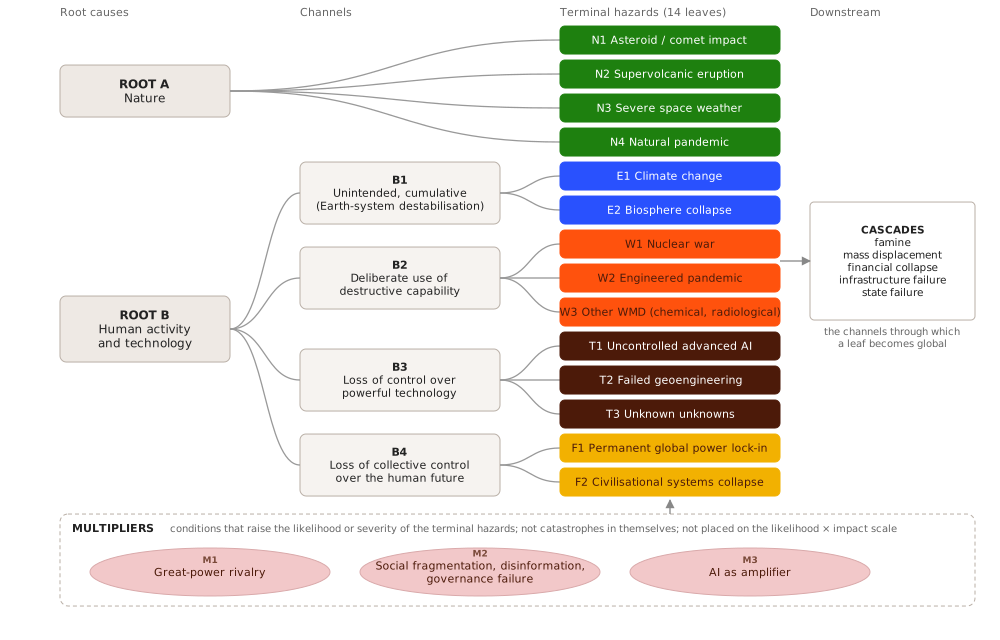
The list is organised as a tree adapted from Bostrom’s work: the division of risks from nature, from unintended consequences and from hostile acts (Bostrom & Ćirković, 2008), the recurring channels of anthropogenic catastrophe in the vulnerable world hypothesis (Bostrom, 2019), and the typology of failure modes as bangs, crunches, shrieks and whimpers (Bostrom, 2002). Two roots, nature and human activity, give rise to four channels under the second root: unintended cumulative consequences, deliberate use of destructive capability, loss of control over powerful technology, and loss of collective control over the human future. Fourteen terminal hazards, the leaves, are the events that actually happen and the only nodes scored on the likelihood × impact map. Three multipliers are conditions that raise the probability or severity of the leaves without being catastrophes in themselves; they are assessed qualitatively and kept off the scale. Five cascades, famine, mass displacement, financial collapse, infrastructure failure and state failure, are the downstream channels through which almost any leaf becomes global; they are listed once and never as risks. The structure follows the classification logic of Avin et al. (2018) in separating the hazard from its mechanism of spread, and the defence-in-depth logic of Cotton-Barratt et al. (2020) in keeping the amplifying conditions visible.
Three structural decisions deserve explicit justification. Earth-system tipping points are treated as the non-linear tail of the cumulative leaves rather than as a leaf, because they are what climate change and biosphere degradation become past thresholds (Lenton et al., 2019; Armstrong McKay et al., 2022; Kemp et al., 2022). Artificial intelligence is treated as a multiplier embedded in the leaves it facilitates, with one exception: the loss of human control over advanced AI is itself a terminal hazard. And great-power conventional war is treated as the precursor stage of nuclear war rather than as a leaf, on the argument that in the nuclear age a great-power war reaching catastrophic scale without nuclear use is barely plausible.
3.3 Likelihood and impact
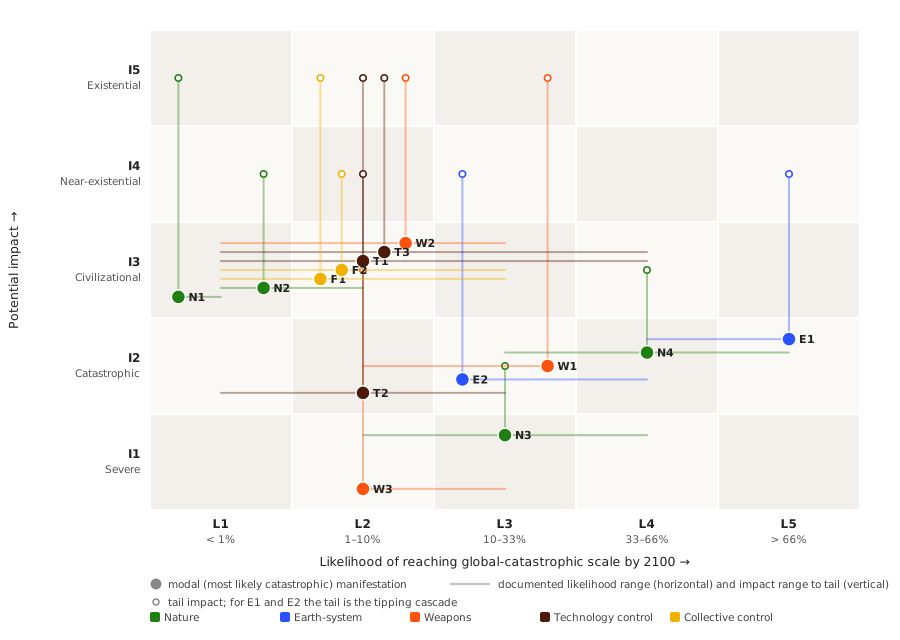
Following Willis et al. (2024), who explicitly decline to assign probabilities to global catastrophic hazards, and the critique of quantification in Beard et al. (2020), the assessment is relative, ordinal and range-based. Likelihood is the probability that the hazard reaches the global-catastrophic threshold at least once by 2100, in five bands (L1, below one percent; L2, one to ten percent; L3, ten to thirty-three percent; L4, thirty-three to sixty-six percent; L5, above sixty-six percent). Impact is assessed across mortality, well-being, breadth, reversibility and intergenerational loss, in five bands from I1 (severe: the catastrophic threshold reached, fully recoverable) through I2 (catastrophic), I3 (civilizational) and I4 (near-existential) to I5 (existential: extinction or permanent foreclosure of humanity’s potential), with reversibility treated as a step-change. Each leaf is scored as a range: a modal manifestation, its most probable catastrophic form, and a tail, its worst case at lower probability. The existential tail is where existential risk lives. Confidence is stated separately, following the IPCC convention of separating likelihood from confidence (IPCC, 2023). The evidence base combines published structured estimates (Ord, 2020), expert-judgment and forecasting exercises (Sandberg & Bostrom, 2008; Karger et al., 2023), the six reference reports (United Nations, 2024, 2026; Willis et al., 2024; Global Challenges Foundation, 2026; HM Government, 2025; World Economic Forum, 2026), and domain base rates where they exist. Perception surveys, including the UN reports, are used as evidence about attention rather than hazard: a shift in perception never moves a band on its own. Likelihood and impact are never multiplied into a single number, in deference to the well-known defects of risk matrices (Cox, 2008).
3.4 Four governance pillars and a maturity indicator
For each of the seventeen risks, the multilateral institutions and treaties whose mandate covers the risk were inventoried under four pillars that correspond to the functions identified in Section 2.2: Assess (standing intergovernmental bodies that produce authoritative knowledge of the risk and detect or monitor it), Regulate (treaties and other instruments that commit states to reduce it), Finance (dedicated intergovernmental funds for proactive reduction, as distinct from response after the fact) and Enforce (bodies with independent power to verify compliance and respond to non-compliance). A mechanism is counted only if it is intergovernmental and multilateral, constituted by or open to states from at least two continents; national instruments and single-continent bodies are excluded, and public-private partnerships or scientific unions are noted but not scored. For each mechanism the dataset records its type, its coverage in number of governments, its position on a bindingness ladder (binding and verified; binding; soft law; advisory) and, for enforcement bodies, its powers and the effectiveness of their use (Cherlet, 2026b).
Each pillar is then scored from 0 (nothing dedicated) to 3 (standing, near-universal, substantive and, for enforcement, verified with sanction power used to effect). The four scores roll up into a five-level maturity indicator: fully developed (10–12 with binding rules at 3 and enforcement at 2 or more, no pillar absent), developed (7–9 with binding rules at 2 or more, no pillar absent), developing (4–6 with at least one pillar at 2 or more, or any higher score with a pillar absent), nascent (1–3, or 4–6 with no pillar above 1) and non-existent (0). One gate is applied: where the states whose behaviour predominantly determines the risk are not bound by the regime’s substantive obligations or are structurally immune from its enforcement, maturity is capped at developing whatever the sum. This is the inclusiveness condition of the regime-effectiveness literature made explicit, and, as Section 5 shows, it is what keeps the indicator honest about nuclear war and great-power rivalry. The benchmark for “fully developed” is a solved problem: the ozone regime, whose Vienna Convention and Montreal Protocol are the only universally ratified treaties in UN history and which combined binding, adjustable controls, mandatory reporting, a financed transition and a non-compliance procedure with trade sanctions (Benedick, 1998; Parson, 2003).
4. The risk universe
Figure 1 shows the tree. Figure 2 places the fourteen terminal hazards on the likelihood × impact plane, with the modal manifestation as a filled point, the documented likelihood range as a horizontal bar and the impact range to the tail as a vertical bar. Table 1 gives the underlying scores.
4.1 Nature
The four natural hazards are the best characterised and, with one exception, the least probable. Asteroid or comet impact (N1) is uniquely quantifiable from survey data and has an existential ceiling at negligible probability; Ord (2020) puts the existential tail at about one in a million this century. Supervolcanic eruption (N2) is more probable than a large impact and currently unpreventable, and its global effect runs through the same channel as nuclear winter, a multi-year collapse of harvests; Mani et al. (2021) and Cassidy and Mani (2022) argue that even lower-magnitude eruptions near critical infrastructure could produce global catastrophic effects and that preparation lags far behind the hazard. Severe space weather (N3) is the most probable natural hazard on the list and the one whose catastrophic form is entirely a product of human infrastructure: a Carrington-class geomagnetic storm threatens power grids and satellites rather than people directly (Eastwood et al., 2017). A natural pandemic (N4) was realised within living memory and is the only natural hazard with a high probability of recurrence at catastrophic scale; six years after COVID-19, the UN survey finds pandemics fallen out of every region’s top ten risks, a shift the report itself warns should not be read as reduced hazard (United Nations, 2026).
4.2 Earth-system destabilisation
Climate change (E1) is the only hazard whose modal manifestation is judged very likely (L5). Its most likely form is a whimper, catastrophic harm by the well-being route as hundreds of millions lose livelihood and habitability (IPCC, 2023), and its tail is a tipping cascade that converts the whimper into a bang and lifts the ceiling to near-existential (Lenton et al., 2019; Armstrong McKay et al., 2022; Kemp et al., 2022). It remains the single most important risk in both UN surveys and the largest node in the 2026 interconnection network, a pure driver with five outgoing links and none incoming (United Nations, 2026). Biosphere collapse (E2) absorbs biodiversity loss, resource depletion and pollution as one mechanism: the crossing of planetary boundaries on land, freshwater, biogeochemical flows and novel entities (Rockström et al., 2009; Steffen et al., 2015; Richardson et al., 2023). Its tipping tail is the same as that of climate change and its governance space is largely separate. The 2026 UN survey records the largest fall in perceived importance for biodiversity and pollution of any risk, and simultaneously names shortages of natural resources as one of the four drivers of geopolitical tension (United Nations, 2026).
| Code | Terminal hazard | Likelihood (modal, range) | Impact (modal → tail) | Failure mode | Confidence |
|---|---|---|---|---|---|
| N1 | Asteroid / comet impact | L1 (L1–L1) | I3 → I5 | bang | High |
| N2 | Supervolcanic eruption | L1 (L1–L2) | I3 → I4 | bang | Moderate |
| N3 | Severe space weather | L3 (L2–L4) | I1 → I2 | bang | Moderate |
| N4 | Natural pandemic | L4 (L3–L5) | I2 → I3 | bang | Moderate–High |
| E1 | Climate change | L5 (L4–L5) | I2 → I4 | whimper → bang | Mod–High (GCR) / Low (tail) |
| E2 | Biosphere collapse | L3 (L3–L4) | I2 → I4 | whimper → bang | Moderate |
| W1 | Nuclear war | L3 (L2–L3) | I2 → I5 | bang | Moderate |
| W2 | Engineered pandemic | L2 (L1–L3) | I3 → I5 | bang | Low |
| W3 | Other WMD (chemical, radiological) | L2 (L2–L3) | I1 → I3 | bang | Moderate |
| T1 | Uncontrolled advanced AI | L2 (L1–L4) | I3 → I5 | bang or shriek | Low (widest disagreement) |
| T2 | Failed geoengineering | L2 (L1–L3) | I2 → I4 | bang | Low |
| T3 | Unknown unknowns | L2 (L1–L4) | I3 → I5 | any | Very low |
| F1 | Permanent global power lock-in | L2 (L1–L3) | I3 → I5 | shriek | Low |
| F2 | Civilisational systems collapse | L2 (L1–L3) | I3 → I4 | crunch | Low |
4.3 Deliberate use of destructive capability
Nuclear war (W1) retains the fattest near-term tail on the map. A limited exchange is its modal form; the tail is a large exchange followed by nuclear winter, whose agricultural consequences could kill billions (Robock et al., 2007; Xia et al., 2022). Ord (2020) places the existential tail at about one in a thousand this century. Two developments push the leaf upward: the expiry of New START in February 2026 without a successor, leaving no treaty limit on the two largest arsenals for the first time since 1972, and the integration of AI into command, targeting and early-warning systems, which compresses decision time and raises the chance of inadvertent escalation (Global Challenges Foundation, 2026). Large-scale war is the only risk in the 2026 UN survey to sit in the top six on importance, imminence, interconnection and lack of preparedness at once (United Nations, 2026). An engineered pandemic (W2) is the accidental or deliberate half of what the UN reports call biorisks. It is the leaf where the existential tail is most plausibly reached by a single actor, because a designed pathogen can combine transmissibility and lethality that natural evolution does not select for, and because the barrier of expertise is being lowered by biological design tools (Millett & Snyder-Beattie, 2017; Ord, 2020). Other weapons of mass destruction (W3), chemical and radiological, are held as a separate leaf by mechanism, with a generally sub-existential ceiling because the harm is bounded by the quantity deployed.
4.4 Loss of control over powerful technology
Uncontrolled advanced AI (T1) is the leaf with the widest range and the lowest confidence. Its modal manifestation is civilizational and its tail existential, whether as a bang or as a shriek in which a misaligned system entrenches an outcome no one chose (Bostrom, 2013; Ord, 2020). The UN Independent International Scientific Panel on AI, established in 2025, reported in July 2026 that no technical guarantee yet exists that frontier systems follow instructions (UN Independent International Scientific Panel on AI, 2026). The 2026 UN survey records the sharpest rise in perceived importance of any risk for AI and frontier technologies and ranks multilateral preparedness for it twenty-fourth of twenty-eight (United Nations, 2026). Failed geoengineering (T2) covers the deployment of solar radiation modification or large-scale carbon removal that ends in termination shock, regional catastrophe or conflict over the thermostat (Reynolds, 2019); it is the second-least-prepared-for risk in the UN survey. Unknown unknowns (T3) are kept explicit: Ord (2020) assigns unforeseen anthropogenic risks a probability comparable to the known ones, and Bostrom’s (2019) “type-0” vulnerability, a technology that is easy to use and catastrophic by default, has no entry on any list until it appears.
4.5 Loss of collective control over the human future
Permanent global power lock-in (F1) is Bostrom’s shriek: a non-extinction existential outcome in which a state, a coalition or a small set of firms uses transformative technology to entrench dominance beyond challenge (Bostrom, 2013; Ord, 2020). Inequality is its economic precursor and the collapse of the rule of law its political one; the UN reports name the risk almost exactly as “technology-driven power concentration” and, in 2026, identify the reinforcing loop between AI and power concentration as the only two-way link within a single category of the network (United Nations, 2024, 2026). Civilisational systems collapse (F2) is the crunch: a self-reinforcing polycrisis across tightly coupled financial, energy, food and infrastructural systems that crosses into irreversible loss of the capacity to sustain complex society (World Economic Forum, 2026). Its enabling condition is coupling itself, which is why the recoverable financial crises that the international system handles well are cascades rather than leaves.
4.6 Multipliers
Three conditions raise the probability or severity of every leaf without being catastrophes in themselves. Great-power rivalry (M1) is the trigger for nuclear use, the engine of racing dynamics in AI and the solvent of the cooperation every other regime requires; the 2026 UN backcast from large-scale war identifies four drivers of geopolitical tension, resource shortage, economic fragmentation, misinformation and weakening multilateral institutions, which the tree reads as the Earth-system, economic and information layers all feeding the war pathway (United Nations, 2026). Social fragmentation, disinformation and governance failure (M2) is the meta-multiplier that degrades response capacity to everything; mis- and disinformation remains the most imminent risk in both UN surveys, the collapse of the rule of law is the most connected node in the 2026 network and the collapse of social cohesion its terminal sink (United Nations, 2024, 2026). AI as amplifier (M3) lowers the cost of pathogen design, compresses nuclear decision time and industrialises synthetic disinformation, and is distinct from T1, where the technology itself is the hazard.
5. The multilateral governance of each risk
Table 2 summarises the inventory. This section walks through it by cluster, naming the principal mechanisms and the gap.
| Code | Risk | Assess | Regulate | Finance | Enforce | Sum | Maturity | Trend |
|---|---|---|---|---|---|---|---|---|
| N1 | Asteroid / comet impact | 2 | 1 | 0 | 0 | 3 | Nascent | → |
| N2 | Supervolcanic eruption | 1 | 1 | 0 | 0 | 2 | Nascent | → |
| N3 | Severe space weather | 2 | 1 | 0 | 0 | 3 | Nascent | → |
| N4 | Natural pandemic | 3 | 2 | 2 | 1 | 8 | Developed | → |
| E1 | Climate change | 3 | 2 | 3 | 1 | 9 | Developed | ↓ |
| E2 | Biosphere collapse | 2 | 2 | 2 | 1 | 7 | Developed | → |
| W1 | Nuclear war | 3 | 2 | 1 | 2 | 8 | Developing (capped) | ↓ |
| W2 | Engineered pandemic | 1 | 2 | 1 | 1 | 5 | Developing | → |
| W3 | Other WMD (chemical, radiological) | 3/2 | 3/2 | 2/2 | 3/1 | 9 | Developed (chemical: fully developed) | → |
| T1 | Uncontrolled advanced AI | 2 | 1 | 0 | 0 | 3 | Nascent | ↑ |
| T2 | Failed geoengineering | 2 | 1 | 0 | 0 | 3 | Nascent | → |
| T3 | Unknown unknowns | 1 | 0 | 0 | 0 | 1 | Nascent | → |
| F1 | Permanent global power lock-in | 1 | 1 | 1 | 1 | 4 | Nascent | ↓ |
| F2 | Civilisational systems collapse | 2 | 1 | 2 | 1 | 6 | Developing | → |
| M1 | Great-power rivalry | 2 | 2 | 2 | 1 | 7 | Developing (capped) | ↓ |
| M2 | Social fragmentation, disinformation, governance failure | 1 | 1 | 1 | 1 | 4 | Nascent | ↓ |
| M3 | AI as amplifier | 2 | 1 | 0 | 0 | 3 | Nascent | ↑ |
| — | Ozone depletion (benchmark) | 3 | 3 | 3 | 3 | 12 | Fully developed | → |
5.1 Natural hazards: knowledge without rules
The three geophysical and astrophysical hazards are governed only at the knowledge end. Asteroid detection is operational through the UN-endorsed International Asteroid Warning Network and the Space Mission Planning Advisory Group, and deflection is technically proven, but no treaty, protocol or fund addresses who authorises or commands a deflection; the Outer Space Treaty is silent on the matter. No intergovernmental body monitors supervolcanic systems as a global hazard, and nothing addresses the defining threat of a multi-year global harvest failure, a gap the volcanological community has itself flagged (Cassidy & Mani, 2022). Space-weather forecasting is coordinated through the World Meteorological Organization and the International Civil Aviation Organization, whose standards bind aviation, but no resilience standard exists for the electricity grids that make the hazard catastrophic (Eastwood et al., 2017). All three score nascent. The natural pandemic is the exception. The World Health Organization’s surveillance architecture is the strongest detection system of any risk on the map; the International Health Regulations bind 196 states, though their obligations are largely procedural and compliance is unenforced (Gostin & Katz, 2016); the Pandemic Agreement adopted in May 2025 remains outside signature until its pathogen access and benefit-sharing annex is agreed, now not before 2027; the Pandemic Fund is dedicated but capitalised at a fraction of need; and the United States left the organisation in January 2026. The regime is developed, and it has no teeth.
5.2 Earth-system: comprehensive architecture, weak outcomes
Climate change has the most complete architecture of any risk: an exemplary assessment body in the IPCC, a near-universal framework convention and Agreement, the largest dedicated finance of any regime, and a facilitative compliance mechanism. It is nonetheless a regime of pledge and review whose substantive targets are not binding (Falkner, 2016), whose finance remains far below need, whose second-largest emitter withdrew in January 2026, and whose compliance committee is by design non-punitive. The International Court of Justice’s advisory opinion of July 2025, holding that states have binding obligations to prevent significant climate harm, opens an adjudicative route that did not previously exist (International Court of Justice, 2025), but it is a route into litigation, not an enforcement mechanism. The regime is developed with enforcement scored at one: an effectiveness gap rather than an architecture gap. Biosphere collapse has a broad but weaker mirror image of the same structure: an assessment platform (IPBES) that is broad rather than universal; a Convention on Biological Diversity to which the United States is not party and whose Kunming-Montreal targets are voluntary; a set of binding sectoral instruments on trade in species and on chemicals, the first of which, CITES, does enforce through trade suspensions; a High Seas Treaty in force since January 2026; and finance an order of magnitude short of the target that was missed in 2025. The regime sits at the floor of the developed band.
5.3 Weapons: the strongest regime and the weakest, side by side
The chemical-weapons regime is the only live regime to reach the benchmark. The Chemical Weapons Convention binds 193 states, its verification is independent and intrusive, all declared stockpiles were destroyed by July 2023, the Organisation for the Prohibition of Chemical Weapons has attributed use and suspended a state party’s rights, and destruction was financed when needed. It scores eleven of twelve: fully developed. Its biological counterpart is the mirror opposite. The Biological Weapons Convention binds 189 states with a prohibition that has had no verification body for fifty years, after the collapse of protocol negotiations in 2001; its confidence-building measures are voluntary and submitted by roughly half of parties; its complaint procedure to the Security Council has never been used; and nothing in it addresses dual-use research or AI-enabled biological design. The engineered pandemic is governed by a prohibition that cannot detect cheating, facing a technology that is dissolving the barrier of expertise (Millett & Snyder-Beattie, 2017). It scores developing.
Nuclear war illustrates why the critical-actor gate is necessary. On paper the regime is developed: near-universal non-proliferation with world-class safeguards, an operational test-monitoring system even though its treaty is not in force, a Security Council that has imposed sanctions for proliferation, and, since 2025, a UN scientific panel studying the effects of nuclear war for the first time since 1988 (United Nations General Assembly, 2024b). But the regime governs who may acquire nuclear weapons far better than whether the nine possessors use them. All nine sit outside any numerical limit on their arsenals; the disarmament obligation of Article VI is unenforced; the prohibition treaty has no nuclear-armed party; and the bilateral layer that limited the two largest arsenals lapsed in February 2026 with no successor and no negotiation. The states whose behaviour determines the risk are bound by nothing that constrains it. The gate caps the regime at developing, and the trend is down.
5.4 Technology: assessment arrived, nothing else
The three loss-of-control hazards share a pattern. For advanced AI, the Assess pillar came into existence in 2025 and 2026: a UN scientific panel modelled on the IPCC, an intergovernmentally backed International AI Safety Report, and a network of national safety institutes that does not include China. The Regulate pillar is soft: a UNESCO recommendation, OECD principles, General Assembly resolutions, a G7 code of conduct and company commitments. The first binding AI treaty, the Council of Europe’s Framework Convention, is rights-focused, excludes national security and, with a single ratification, is not in force (Council of Europe, 2024). No instrument addresses frontier-model safety, compute or loss of control; there is no fund and no enforcement. The two states that host roughly ninety percent of frontier training compute are bound by nothing (Tallberg et al., 2023; Ho et al., 2023). Geoengineering is assessed inside other regimes, the IPCC, UNEP and the Montreal Protocol’s scientific panel, and regulated only at the margins: the ENMOD Convention bans hostile environmental modification, the Convention on Biological Diversity’s decision X/33 is a non-binding moratorium to which the United States is not party, the London Protocol’s 2013 amendment on marine geoengineering is not in force, and two attempts to open the question at the UN Environment Assembly were withdrawn (Reynolds, 2019). Nothing governs stratospheric aerosol injection, research thresholds or termination shock. Unknown unknowns have a foresight function in the UN’s biennial risk report and the Pact’s commitment to strategic foresight, and no institution. All three are nascent.
5.5 Collective control: the least governed
Permanent power lock-in is among the least governed risks on the map. There is no global competition law; the OECD/G20 two-pillar tax settlement, the one instrument that touched the concentration of corporate power, lost its first pillar and had its second weakened in January 2026, while a UN tax convention is still under negotiation. The binding instruments that bear on the terminal form of the risk, the Covenant on Civil and Political Rights and the Rome Statute, address the abuse of concentrated power after the fact and exclude the largest powers. No body assesses the concentration of transformative technology as a catastrophic risk. With every pillar at one, the risk is nascent and the trend is down. Civilisational systems collapse presents the opposite asymmetry: its financial channel is well governed, by the Financial Stability Board, the IMF’s surveillance and lending, the Basel standards and WTO adjudication, while the cross-sector cascade that defines the leaf has no integrated assessment, no binding standard for infrastructure interdependence and a cybercrime convention with three ratifications. The financial sub-regime alone would score developed; the risk scores developing.
5.6 Multipliers: the architecture that cannot act
Great-power rivalry has the most complete architecture on paper, the Charter system itself: a universal prohibition on the use of force, universal humanitarian law, a Security Council with binding sanctioning power and a Court with compulsory jurisdiction for seventy-four states. It is structurally unable to act when a permanent member is the aggressor, and no conventional or strategic arms control between great powers remains in force. The gate caps it at developing; the 2026 UN survey finds large-scale war fell fastest in preparedness of any risk and weak governance mechanisms the top barrier to reducing every risk (United Nations, 2026). Social fragmentation and disinformation, the meta-multiplier, has no dedicated assessment body, no instrument beyond human-rights law and the non-binding Global Digital Compact, negligible finance and peer review as its only response system: nascent, and eroding, with confidence in institutions’ capacity to reduce risk down for twenty-three of twenty-eight risks between the two UN surveys. AI as amplifier is governed by declarations: a General Assembly resolution on military AI, the REAIM blueprint, a US-led political declaration, and a Convention on Certain Conventional Weapons process on autonomous weapons whose expert group closed in September 2026 with a diluted text and whose fate rests with a review conference in November (Maas, 2019). Nothing addresses AI in nuclear command and control or in pathogen design; those convergences fall between the nuclear, biological and AI regimes and are owned by none.
6. Discussion: what the multilateral system is doing, and not doing
Six patterns run across the inventory, and each connects to a result in the literature reviewed in Section 2.
The system assesses far better than it regulates, finances or enforces. Summed across the seventeen risks, the pillar scores fall monotonically from Assess (33 of 51) through Regulate (24) and Finance (17) to Enforce (13). The further a function sits from knowledge and the closer to compulsion, the less of it exists. This is the first of Haas, Keohane and Levy’s (1993) three Cs delivered without the other two, and it is what the UN’s own respondents report when they rate institutions stronger at identifying risks than at reducing them and, by eighty-six percent, call reduction funding inadequate (United Nations, 2026).
Only one live regime reaches the benchmark, and it shares the ozone recipe. The chemical-weapons regime and the ozone regime alone combine binding rules, independent verification with sanctioning power, near-universal membership including the critical actors, and financed implementation. Every other regime is missing at least one ingredient: verification in the biological regime, arsenal limits in the nuclear one, enforcement in the climate one, universality in the biodiversity one, everything in the technological cluster. Mitchell’s (1994) finding that compliance information and response systems are what distinguish effective from ineffective regimes is confirmed at the scale of the whole risk universe.
Governance maturity is inversely related to the novelty and velocity of the risk. The nascent band contains the newest and fastest-moving hazards, advanced AI, AI-enabled biology, geoengineering, power lock-in and the information environment, together with the oldest orphans among the natural hazards. The developed band contains older, more discrete and slower hazards. The frontier of risk has outrun the frontier of governance, and the 2026 UN survey ranks the four technological risks twenty-second, twenty-fourth, twenty-sixth and twenty-seventh of twenty-eight for preparedness (United Nations, 2026). This is Sears’s (2021) oscillation observed in cross-section: the institutions that exist were built in the cooperative moments of an earlier technological era.
The critical-actor gate bites where the stakes are highest. Nuclear war and great-power rivalry both score in the developed range on paper and are capped because the states that generate the risk are outside the limits or immune from enforcement. Downs, Rocke and Barsoom (1996) predicted that where the gains from defection are largest, deep commitments will not be made without enforcement; the two risks with the fattest near-term tails are governed by architectures that cannot bind their principals.
Multilateralism is eroding as the risks rise. Between the two UN surveys the following occurred: New START expired; the United States withdrew from the World Health Organization and the Paris Agreement; the global minimum tax was hollowed out; the pandemic agreement’s annex missed its deadline; the autonomous-weapons process closed with a diluted text; a state withdrew from the International Criminal Court; UN peacekeeping was cut. Against this, the High Seas Treaty entered into force, the European Union ratified the AI convention, the UN AI panel delivered its first report, UN sanctions on Iran were restored, and the nuclear-war effects panel began work. Five risks carry a downward trend; two carry an upward one. Zürn’s (2018) account of a global governance system whose authority is contested as it grows describes the moment precisely, except that here the authority is being withdrawn from the risks where it is most needed.
Governance is siloed while risks are interconnected, and the seams are where the new risks live. The regime complexes described by Keohane and Victor (2011) and the fragmentation analysed by Biermann et al. (2009) are visible in every cluster, but the sharpest consequence is at the intersections: the AI-biology convergence falls between the biological and AI regimes, the AI-nuclear nexus between the nuclear and AI regimes, the resource-rivalry link that the UN backcast names between the environmental and security regimes. The 2026 network shows every pathway discharging into displacement and the collapse of social cohesion; no mechanism owns a cascade.
Legal form, finally, is not effectiveness. Paris is binding and under-performs; the biological convention is binding and unverifiable; the Financial Stability Board is soft law and works; CITES enforces with trade suspensions inside a treaty whose headline targets are voluntary. This is the Abbott and Snidal (2000) result restated: what matters is the combination of obligation, precision and delegation, and delegation to a body that can verify and respond is the ingredient most often absent. It follows that the highest-leverage moves are inside existing instruments, verification for the biological convention, compliance leverage for the health regulations, arsenal limits under the non-proliferation treaty, a non-use agreement or research protocol for solar geoengineering, rather than new treaties.
The limitations of the exercise should be stated plainly. The scores are a single-analyst structured synthesis and should be replaced by structured expert elicitation of the kind the risk literature has called for (Beard et al., 2020; Cremer & Kemp, 2021). The maturity indicator is an indicator of architecture; effectiveness is carried by the enforcement score and the qualitative record, and the two must be read together. The inventory is limited to intergovernmental mechanisms, which excludes the transnational, private and scientific initiatives that fill some of the gaps identified, though their presence in place of an intergovernmental body is itself a finding. And the assessment is a snapshot of a system in motion: several of the figures cited will have changed by the time the next round of conferences, on autonomous weapons, on the prohibition treaty and on biodiversity finance, has concluded.
7. Conclusion
The Pact for the Future committed the member states of the United Nations to strengthen the international response to global catastrophic and existential risks. This article has asked what that commitment meets when it reaches the multilateral system as it stands in 2026, and has answered with a structured list of the risks, a relative assessment of their likelihood and impact, and a risk-by-risk inventory of the institutions that exist to assess, regulate, finance and enforce their reduction.
The answer has three parts, and the pattern is the finding. No single risk is fully covered by multilateral governance. Not one of the seventeen live regimes combines binding rules, verification with sanctioning power, near-universal membership including the critical actors, and financed implementation. The recipe that resolved the last global catastrophic risk to be solved, stratospheric ozone depletion, has been reproduced only for chemical weapons, and even there it fails when a state defies the regime under great-power protection. Most risks are partially covered. Four regimes, for natural pandemics, climate change, biosphere collapse and other weapons of mass destruction, are developed and all four lack enforcement. Four more, for nuclear war, engineered pandemics, civilisational collapse and great-power rivalry, are developing, two of them capped because the actors who generate the risk are not bound by the regime that is supposed to contain it. Some risks are not covered at all. Nine risks, the three geophysical hazards, the three loss-of-control technologies, power lock-in, the information environment and AI as an amplifier, have no binding instrument in force on the risk itself; several have nothing beyond an assessment function, and unknown unknowns have nothing beyond a biennial report.
The distribution is not random. The most mature architectures govern the oldest and slowest hazards; the cluster in which the existential tails concentrate is governed by declarations; and the two risks with the fattest near-term tails are governed by institutions designed for exactly those risks and structurally unable to act against their principals. Governance is strongest where it is least needed and weakest where it is most needed, and the multilateral system that would have to close the gap is itself eroding. The Pact’s language is, on this evidence, a diagnosis rather than a remedy. Turning it into a remedy does not primarily require new treaties. It requires giving the treaties that exist the compliance information and response systems that the effectiveness literature identified thirty years ago as the difference between rules on paper and changed behaviour, and building, for the risks that have no rules at all, at least the assessment function that the climate regime shows to be the first step. Whether the moment permits that is a question this article cannot answer. That it is the question, the inventory makes plain.
References
Abbott, K. W., & Snidal, D. (2000). Hard and soft law in international governance. International Organization, 54(3), 421–456.
Armstrong McKay, D. I., Staal, A., Abrams, J. F., Winkelmann, R., Sakschewski, B., Loriani, S., Fetzer, I., Cornell, S. E., Rockström, J., & Lenton, T. M. (2022). Exceeding 1.5°C global warming could trigger multiple climate tipping points. Science, 377(6611), eabn7950.
Avin, S., Wintle, B. C., Weitzdörfer, J., Ó hÉigeartaigh, S. S., Sutherland, W. J., & Rees, M. J. (2018). Classifying global catastrophic risks. Futures, 102, 20–26.
Beard, S., Rowe, T., & Fox, J. (2020). An analysis and evaluation of methods currently used to quantify the likelihood of existential hazards. Futures, 115, 102469.
Benedick, R. E. (1998). Ozone diplomacy: New directions in safeguarding the planet (2nd ed.). Harvard University Press.
Biermann, F., Pattberg, P., van Asselt, H., & Zelli, F. (2009). The fragmentation of global governance architectures: A framework for analysis. Global Environmental Politics, 9(4), 14–40.
Bostrom, N. (2002). Existential risks: Analyzing human extinction scenarios and related hazards. Journal of Evolution and Technology, 9(1).
Bostrom, N. (2013). Existential risk prevention as global priority. Global Policy, 4(1), 15–31.
Bostrom, N. (2019). The vulnerable world hypothesis. Global Policy, 10(4), 455–476.
Bostrom, N., & Ćirković, M. M. (Eds.). (2008). Global catastrophic risks. Oxford University Press.
Boyd, M., & Wilson, N. (2020). Existential risks to humanity should concern international policymakers and more could be done in their regulation. Risk Analysis, 40(11), 2303–2312.
Cassidy, M., & Mani, L. (2022). Huge volcanic eruptions: Time to prepare. Nature, 608(7923), 469–471.
Chayes, A., & Chayes, A. H. (1995). The new sovereignty: Compliance with international regulatory agreements. Harvard University Press.
Cherlet, J. (2026a). GlobalRisks dataset (Version 3.2) [Data set]. Global Risk Governance Monitor. https://globalriskgovernance.org
Cherlet, J. (2026b). RiskGovernance dataset (Version 3.1) [Data set]. Global Risk Governance Monitor. https://globalriskgovernance.org
Cotton-Barratt, O., Daniel, M., & Sandberg, A. (2020). Defence in depth against human extinction: Prevention, response, resilience, and why they all matter. Global Policy, 11(3), 271–282.
Council of Europe. (2024). Framework Convention on Artificial Intelligence and Human Rights, Democracy and the Rule of Law (CETS No. 225).
Cox, L. A. (2008). What’s wrong with risk matrices? Risk Analysis, 28(2), 497–512.
Cremer, C. Z., & Kemp, L. (2021). Democratising risk: In search of a methodology to study existential risk. Centre for the Study of Existential Risk, University of Cambridge.
Downs, G. W., Rocke, D. M., & Barsoom, P. N. (1996). Is the good news about compliance good news about cooperation? International Organization, 50(3), 379–406.
Eastwood, J. P., Biffis, E., Hapgood, M. A., Green, L., Bisi, M. M., Bentley, R. D., Wicks, R., McKinnell, L.-A., Gibbs, M., & Burnett, C. (2017). The economic impact of space weather: Where do we stand? Risk Analysis, 37(2), 206–218.
Falkner, R. (2016). The Paris Agreement and the new logic of international climate politics. International Affairs, 92(5), 1107–1125.
Global Challenges Foundation. (2026). Global catastrophic risks 2026. Global Challenges Foundation.
Gostin, L. O., & Katz, R. (2016). The International Health Regulations: The governing framework for global health security. The Milbank Quarterly, 94(2), 264–313.
Haas, P. M., Keohane, R. O., & Levy, M. A. (Eds.). (1993). Institutions for the Earth: Sources of effective international environmental protection. MIT Press.
HM Government. (2025). National Risk Register 2025 edition. Cabinet Office.
Ho, L., Barnhart, J., Trager, R., Bengio, Y., Brundage, M., Carnegie, A., Chowdhury, R., Dafoe, A., Hadfield, G., Levi, M., & Snidal, D. (2023). International institutions for advanced AI. arXiv:2307.04699.
Intergovernmental Panel on Climate Change. (2023). Climate change 2023: Synthesis report. IPCC.
International Court of Justice. (2025). Obligations of States in respect of climate change (Advisory Opinion of 23 July 2025).
Karger, E., Rosenberg, J., Jacobs, Z., Hickman, M., Hadshar, R., Gamin, K., Smith, T., Williams, B., McCaslin, T., & Tetlock, P. E. (2023). Forecasting existential risks: Evidence from a long-run forecasting tournament (Working Paper No. 1). Forecasting Research Institute.
Kemp, L., Xu, C., Depledge, J., Ebi, K. L., Gibbins, G., Kohler, T. A., Rockström, J., Scheffer, M., Schellnhuber, H. J., Steffen, W., & Lenton, T. M. (2022). Climate endgame: Exploring catastrophic climate change scenarios. Proceedings of the National Academy of Sciences, 119(34), e2108146119.
Keohane, R. O., & Victor, D. G. (2011). The regime complex for climate change. Perspectives on Politics, 9(1), 7–23.
Lenton, T. M., Rockström, J., Gaffney, O., Rahmstorf, S., Richardson, K., Steffen, W., & Schellnhuber, H. J. (2019). Climate tipping points: Too risky to bet against. Nature, 575(7784), 592–595.
Maas, M. M. (2019). How viable is international arms control for military artificial intelligence? Three lessons from nuclear weapons. Contemporary Security Policy, 40(3), 285–311.
Mani, L., Tzachor, A., & Cole, P. (2021). Global catastrophic risk from lower magnitude volcanic eruptions. Nature Communications, 12, 4756.
Millett, P., & Snyder-Beattie, A. (2017). Existential risk and cost-effective biosecurity. Health Security, 15(4), 373–383.
Mitchell, R. B. (1994). Regime design matters: Intentional oil pollution and treaty compliance. International Organization, 48(3), 425–458.
Ord, T. (2020). The precipice: Existential risk and the future of humanity. Bloomsbury.
Parson, E. A. (2003). Protecting the ozone layer: Science and strategy. Oxford University Press.
Reynolds, J. L. (2019). The governance of solar geoengineering: Managing climate change in the Anthropocene. Cambridge University Press.
Richardson, K., Steffen, W., Lucht, W., Bendtsen, J., Cornell, S. E., Donges, J. F., Drüke, M., Fetzer, I., Bala, G., von Bloh, W., Feulner, G., Fiedler, S., Gerten, D., Gleeson, T., Hofmann, M., Huiskamp, W., Kummu, M., Mohan, C., Nogués-Bravo, D., … Rockström, J. (2023). Earth beyond six of nine planetary boundaries. Science Advances, 9(37), eadh2458.
Robock, A., Oman, L., & Stenchikov, G. L. (2007). Nuclear winter revisited with a modern climate model and current nuclear arsenals: Still catastrophic consequences. Journal of Geophysical Research: Atmospheres, 112, D13107.
Rockström, J., Steffen, W., Noone, K., Persson, Å., Chapin, F. S., Lambin, E. F., Lenton, T. M., Scheffer, M., Folke, C., Schellnhuber, H. J., Nykvist, B., de Wit, C. A., Hughes, T., van der Leeuw, S., Rodhe, H., Sörlin, S., Snyder, P. K., Costanza, R., Svedin, U., … Foley, J. A. (2009). A safe operating space for humanity. Nature, 461(7263), 472–475.
Sandberg, A., & Bostrom, N. (2008). Global catastrophic risks survey (Technical Report No. 2008-1). Future of Humanity Institute, University of Oxford.
Sears, N. A. (2020). Existential security: Towards a security framework for the survival of humanity. Global Policy, 11(2), 255–266.
Sears, N. A. (2021). International politics in the age of existential threats. Journal of Global Security Studies, 6(3), ogaa027.
Steffen, W., Richardson, K., Rockström, J., Cornell, S. E., Fetzer, I., Bennett, E. M., Biggs, R., Carpenter, S. R., de Vries, W., de Wit, C. A., Folke, C., Gerten, D., Heinke, J., Mace, G. M., Persson, L. M., Ramanathan, V., Reyers, B., & Sörlin, S. (2015). Planetary boundaries: Guiding human development on a changing planet. Science, 347(6223), 1259855.
Tallberg, J., Erman, E., Furendal, M., Geith, J., Klamberg, M., & Lundgren, M. (2023). The global governance of artificial intelligence: Next steps for empirical and normative research. International Studies Review, 25(3), viad040.
Underdal, A. (1992). The concept of regime “effectiveness”. Cooperation and Conflict, 27(3), 227–240.
UN Independent International Scientific Panel on AI. (2026). First report. Presented at the Global Dialogue on AI Governance, Geneva, 6–7 July 2026. United Nations.
United Nations. (2024). Global Risk Report 2024. Executive Office of the Secretary-General.
United Nations. (2026). Global Risk Report 2026. Executive Office of the Secretary-General, with the Lloyd’s Register Foundation Institute for the Public Understanding of Risk.
United Nations General Assembly. (2024a). Pact for the Future (Resolution A/RES/79/1, 22 September 2024).
United Nations General Assembly. (2024b). Nuclear war effects and scientific research (Resolution A/RES/79/238, 24 December 2024).
United Nations Secretary-General. (2021). Our common agenda: Report of the Secretary-General. United Nations.
Willis, H. H., Narayanan, A., Boudreaux, B., Espinosa, B., Geist, E., Gerstein, D. M., Goldfeld, D. A., Kalra, N., LaTourrette, T., Lathrop, E., Moon, A., Osburg, J., & Preston, B. L. (2024). Global catastrophic risk assessment (RRA2981-1). RAND Corporation.
World Economic Forum. (2026). The global risks report 2026 (21st ed.). World Economic Forum.
Xia, L., Robock, A., Scherrer, K., Harrison, C. S., Bodirsky, B. L., Weindl, I., Jägermeyr, J., Bardeen, C. G., Toon, O. B., & Heneghan, R. (2022). Global food insecurity and famine from reduced crop, marine fishery and livestock production due to climate disruption from nuclear war soot injection. Nature Food, 3, 586–596.
Young, O. R. (1999). The effectiveness of international environmental regimes: Causal connections and behavioral mechanisms. MIT Press.
Zürn, M. (2018). A theory of global governance: Authority, legitimacy, and contestation. Oxford University Press.
The two open datasets on which this article rests, the interactive Global Risk Governance Monitor and the full method are available at globalriskgovernance.org.